

By Adam James Abrahami MCP, MA, BA (Hons), CEO & Founder H2o Networks
What recent findings reveal about Wi-Fi and phone signals in care homes…
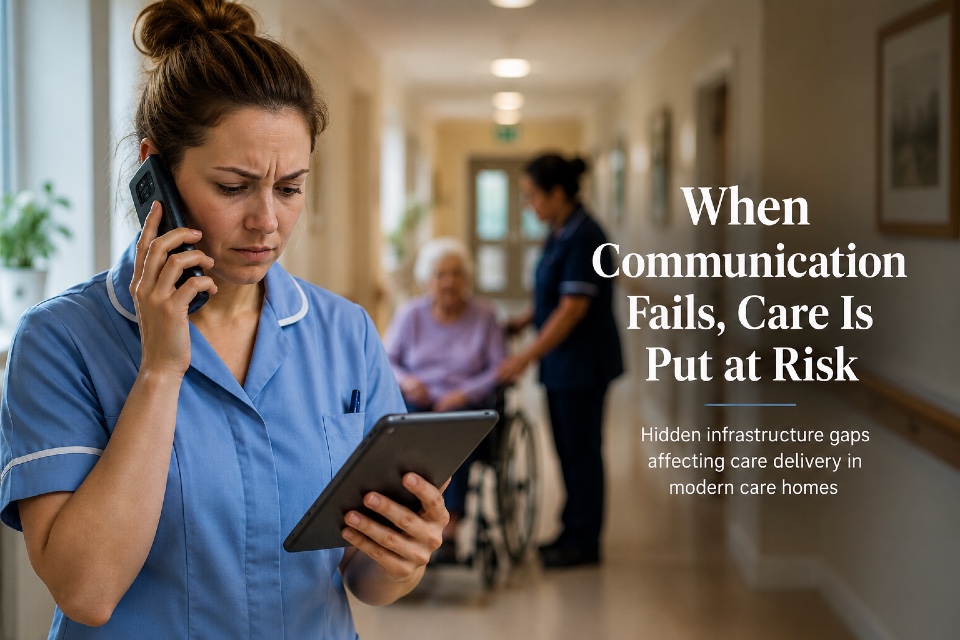
It Started With a Simple Call
It was meant to be straightforward. A member of staff needed to make a call from a resident’s room. They picked up the handset and tried to connect. But the signal wasn’t strong enough. The call didn’t go through.
In that moment, what should have been a routine action became something else entirely uncertain, delayed, and under pressure.
Situations like this don’t always make headlines. But they happen more often than many care providers realise. And when they do, they reveal something deeper.
Not just a signal issue but a gap in how technology supports care.
The Hidden Reality Behind Everyday Systems
In most care homes, communication systems appear to be working. Phones ring. Devices connect. Staff complete tasks. But underneath, there are often small inconsistencies:
- Signal drops in certain areas
- Devices that appear connected but don’t fully sync
- Calls that cut out or fail unexpectedly
- Care planning systems that delay updating notes
These issues are rarely constant. They happen intermittently just enough to be frustrating, but not always enough to trigger immediate action. Until the moment they matter most.
What Managers and Staff Are Experiencing
In conversations with care home managers and staff, these challenges come up regularly. Staff describe needing to move into corridors to get enough signal to make a call. Others mention calls dropping mid-conversation, or delays when trying to reach colleagues or emergency services. There are also frequent issues with care planning systems.
Devices may appear connected, but notes don’t update in real time. Staff complete tasks, only to find information hasn’t synced properly or needs to be re-entered later.
Managers often hear:
- “The phone doesn’t work in that room”
- “I had to step outside to get signal”
- “The call cut out when I was trying to get through”
- “It says it’s connected, but the notes haven’t updated”
Individually, these moments can seem minor. But over time, they create uncertainty about whether systems will perform reliably when they are truly needed.
When Small Gaps Become Serious Risks
In one case encountered during a review of care home infrastructure, a coroner’s report highlighted how serious these issues can become. Staff had been unable to contact emergency services from a handset in a resident’s room because the system relied on infrastructure that had not been properly designed or maintained.
Situations like this are rarely caused by a single failure. They are usually the result of multiple small decisions over time systems added, extended, or adapted without a clear view of how everything works together.
When those gaps are exposed under pressure, the consequences extend far beyond technology.
Why This Is Happening More Often
One of the biggest changes in recent years is how communication systems operate.
Many care homes have moved from traditional phone lines to Voice over Internet Protocol (VoIP) where calls are made over the internet. This brings flexibility and cost savings.
But it also means:
Phones, care systems, monitoring tools, and Wi-Fi are all sharing the same network.
When that network is under strain, everything is affected.
- Calls compete with care planning systems
- Devices struggle to stay connected
- Performance varies depending on location
In environments where multiple systems rely on a single connection, even small weaknesses can have a wider impact.
What Care Providers Should Be Looking At
As reliance on digital systems continues to grow, more providers are beginning to take a step back and ask: How well do our systems actually perform under pressure?
A proactive review typically focuses on:
- Wi-Fi coverage: Are there any dead zones, particularly in resident rooms?
- Device performance: Do systems update in real time, or are there delays?
- Communication reliability: Can calls be made instantly from any location?
- System integration: Do all technologies work together as one environment?
These are not always questions that can be answered by looking at systems on paper. They require testing how systems behave in real conditions.
A More Reliable Approach
In many cases, the solution is not more technology but better alignment.
Ensuring that. The system can handle the demand in terms of internet usage between staff residents and care planning. That the systems are integrated, not layered on top of each other and verified working. You have connectivity is consistent across the entire building and communication tools work at the point of care
Because when systems are designed properly, they become almost invisible.
Staff don’t think about connectivity. Calls go through. Care records update.
Communication flows naturally. This is exactly how it should be.
Final Thoughts
Technology is now a critical part of care delivery. But its value isn’t measured by what it can do it’s measured by how reliably it performs when it matters most.
Many of the risks aren’t obvious until something goes wrong. Which is why more providers are beginning to take a proactive approach identifying gaps early, before they become operational or compliance issues.
Check If Your System is Compliant
Care IT Risk & CQC Readiness Assessment
Many of these gaps aren’t obvious until something goes wrong or until they’re reviewed during an inspection.
For care providers, the challenge isn’t just having systems in place but understanding how well they perform under pressure.
For those looking to get a clearer picture, we’ve developed a simple Care IT Risk & CQC Readiness Assessment designed specifically for care environments.
It highlights potential risks in areas such as care records, connectivity, and system reliability, and provides practical recommendations for improvement.
Learn more or request an assessment here:
https://itforcarehomes.co.uk/risk/
About the Author
Adam Abrahami MCP, MA, BA (Hons) is Founder and CEO of IT For Care Homes and works closely with care providers across the UK to improve IT, connectivity, and communication systems.
He is also a regular contributor to industry events and panel discussions, sharing insights on how technology can better support care delivery and operational efficiency.